A minimal protected housing stock
Dénia, a city of more than 50,000 residents, has a very small protected housing stock. The only official protected housing units built are the 67 at Residencial El Puerto, on Camí dels Lladres, a development that began around 2017. They were built by a private developer and sold at prices between €140,000 and €200,000. They therefore do not form a public rental housing stock.
The figure contrasts with the number of empty homes. A report by CCOO published in February estimated that the municipality has between 5,200 and 5,800 unoccupied dwellings.
What is already available: 46 flats from Casa 47
The main news this month is the arrival of Casa 47, the new state public housing entity. Since September, Dénia has had 46 dwellings included in its first call for applications, with the deadline ending on 21 September. These are not a project: they are already built flats, from Sareb, allocated to affordable rental and to be kept in the public housing stock.
With these, the city has 113 protected or affordable existing homes: the 67 official protected housing units sold and the 46 public rental flats.
What is coming: 236 more dwellings
The offer will grow with two developments with very different characteristics.
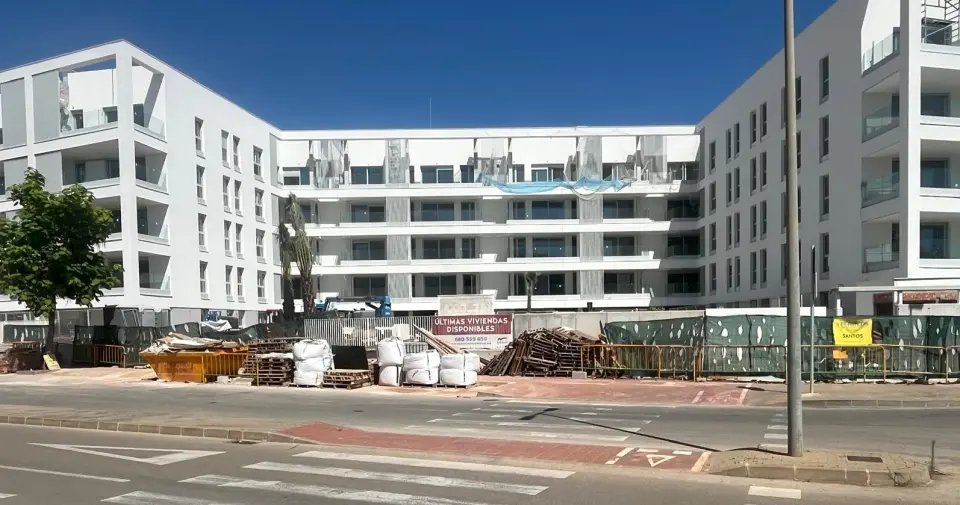
The first, privately developed, is under construction in the same area of Camí dels Lladres, in Les Sorts de la Mar. These are 90 public protected housing units of up to three bedrooms, governed by the access requirements of regional decree 180/2024. Their price is around €260,000 per unit.
The second is public and will be for rental. In February 2025, Instituciones Penitenciarias transferred to the Ministry of Housing the plot of the former railway workers' homes, at number 11 Calle Manuel Lattur, to build protected housing. On its 3,280 square metres of residential urban land, 146 affordable rental homes will be built. The Town Hall reiterated the figure on 8 September.
Combining existing and planned housing, Dénia will have 349 protected or affordable dwellings. Only 192 will be rental: the 46 from Casa 47 and the 146 on the railway land.
Price at the centre of debate
The cost of protected housing for sale has become one of the main points of friction between administrations. Dénia's councillor for Territory and general secretary of the local PSPV, Maria Josep Ripoll, illustrates this with the two developments on Camí dels Lladres: the first sold for between €140,000 and €200,000 per home, and the new one will be around €260,000. In her view, these amounts make it difficult for protected housing to fulfil its function.
The maximum price of these dwellings depends on the module set by the Generalitat. On 14 August, the Generalitat updated it from €2,400 to €2,568 per square metre of useful floor area, a rise of 7%.
The PSPV has brought an initiative to Les Corts to reverse this rise. Its deputy spokesperson, María José Salvador, calculates that with the new module, a protected home of 90 square metres could cost €231,120. If the bank finances 80%, the buyer would need a mortgage of €184,896, with a payment close to €900 per month for 25 years, and contribute a further €46,224 as a down payment, plus taxes and expenses. The Socialists are calling for a return to €2,200 per square metre, to restore the permanent classification of these homes and to reduce the income levels that give access to them.
The Generalitat defends the update. It argues that the module rises by 7% while accumulated construction costs have increased by 21.79%, according to the economic statement accompanying the resolution. The technical report on which it is based, prepared by the Housing Observatory Chair of the Universitat Politècnica de València, puts the increase in construction costs since 2019 at 57%. The Housing Ministry also stresses that the module is a maximum ceiling on sales and that its rise does not necessarily mean that families will pay an equivalent increase. It also recalls that the previous Generalitat increased it by 22.2% in a single update.
The stressed area that does not arrive
Dénia Town Hall has asked the Housing Ministry on several occasions to declare the city a stressed residential market area, a designation that allows measures to contain rental prices. According to Ripoll, it has never received a response.
As alternatives, the municipal government is banking on Casa 47 housing and a new tourism housing ordinance. Ripoll puts at 188 the number of tourist homes in the urban centre that could return to the residential market when their licences expire.
What changes with the new state decree
From this Thursday, 1 October, Royal Decree-Law 26/2026, published in the Official State Gazette on 30 September, adds urgent measures on affordable housing. Its main new features are:
- What is affordable housing. For the first time a definition is set: housing that, including associated costs, does not exceed 30% of the median household income of the municipality in either sale or rental.
- Speculative purchases. Until 31 December 2028, entities dedicated to acquiring real estate are banned from buying homes for less than 70% of their valuation, except in cases such as allocating them to affordable or social housing for at least five years.
- Tourism flats. Rentals of furnished homes for periods of up to 30 nights will be taxed generally under VAT from 1 December 2026, except where the owner rents out their own main residence.
- Sale to the public sector. The gain from selling certain homes to public affordable and social housing entities will be exempt from taxation between 1 October 2026 and 31 December 2027.
- Evictions. Protection against evictions of vulnerable people is extended until 2030 in certain circumstances.
- Public housing stock. The decree includes measures on the property managed by Casa 47 and exempts rehabilitation aid under the State Housing Plan 2026-2030 from taxation.
The Council of Ministers also approved a second decree, focused on the stability of main residence rental contracts, which will be published in the coming days.
The effect of these measures in Dénia remains to be seen. In a city with more than 5,000 registered tourism homes and a protected housing offer of barely a hundred flats, most of the market remains beyond the reach of public housing.