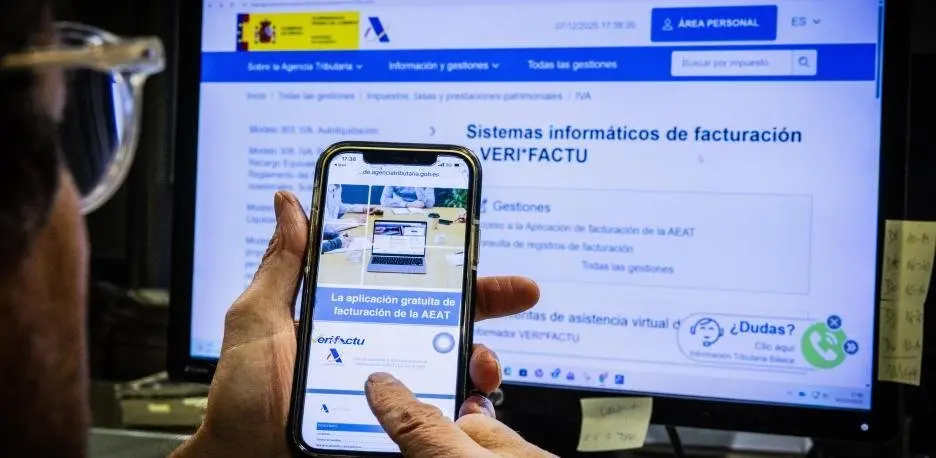
← HomeVerifactu delayed to October 2028: what changes for shops, bars and businesses
The Treasury has delayed until October 2028 the entry into force of Verifactu, which requires businesses to adapt their invoicing software and electronic tills. It has also set the schedule for electronic invoicing between companies: October 2027 for those with turnover exceeding 8 million euros, and October 2028 for the rest, including most self-employed workers and SMEs in the comarca.
La Marina Times newsroom
Tuesday 6 October 2026, 09:37 · 4 min read
Second postponement
The Treasury Ministry announced on Monday, in a press notice, that it is delaying until October 2028 the outstanding obligations of the Regulation on computer invoicing systems, known as Verifactu. This is the second postponement. At the end of 2025, the Government had already delayed its entry into force: companies subject to Corporation Tax were due to comply from 1 January 2027 and other companies and self-employed workers from 1 July 2027.
The Treasury justified the decision on the need to align the timetables of Verifactu and electronic invoicing between companies, so that businesses do not have to adapt their systems in several phases. It also plans to amend the regulations to bring them closer to ViDA, the European directive that will modernise VAT and will be mandatory throughout the Union from 2030.
The postponement is currently contained in the Ministry's press notice and is pending publication in formal legislation. The announcement coincided with the call for general elections on 29 November.
Two distinct obligations
To understand how this affects businesses in the comarca, it is necessary to distinguish two obligations that are often confused:
- Verifactu sets the requirements that invoicing software must meet, including till receipts. It seeks to ensure that records cannot be altered and that the Treasury can verify them. It affects any business that invoices with computer software, including those selling to the end consumer, such as bars, restaurants or shops.
- Mandatory electronic invoicing affects invoices between companies and professionals. It requires them to be issued and received in a structured electronic format, not in PDF, and to report whether they have been accepted and paid.
The new schedule
The Official State Gazette also published on Monday Order HAC/1028/2026, which regulates the Treasury's public electronic invoicing solution and sets out the deadlines. It enters into force on 6 October 2026, and from then:
- 6 October 2027: mandatory electronic invoicing for companies and professionals with a turnover exceeding 8 million euros.
- 6 October 2028: mandatory electronic invoicing for other companies and professionals.
- October 2028: entry into force of Verifactu for all companies and self-employed workers, according to the Treasury press notice.
Companies using private invoicing platforms must send, at the same time as they issue each invoice, a copy in the standard UBL format to the Treasury's public solution.
What it means for Marina Alta
In a comarca where the economy relies on hospitality, retail and services, and which has just closed a summer of record employment, most businesses are small: bars, restaurants, shops, accommodation and self-employed workers with turnover well below 8 million euros.
- Bars, restaurants and shops. Gain almost two years to adapt their tills and invoicing software to Verifactu. Those who have already done so do not lose their investment: they will have the system ready when the obligation arrives.
- Self-employed workers and SMEs that invoice other companies. Will have to issue electronic invoices from October 2028, the same month Verifactu enters into force. The two changes will arrive at the same time, which is what the Treasury intends.
- Large companies. The few in the comarca that exceed 8 million euros in turnover must adapt to electronic invoicing a year earlier, in October 2027.
Relief for the self-employed
The Association of Self-Employed Workers (ATA), chaired by Lorenzo Amor, has welcomed the decision. The organisation has been asking for the Verifactu schedule to be synchronised with the mandatory electronic invoicing schedule and the European ViDA directive. Critics, on the other hand, point out that the new delay prolongs the uncertainty of self-employed workers and small businesses about which invoicing system they should use.
The postponement comes when, just months before the scheduled date, many SMEs and self-employed workers were still not prepared.