A material widely used in Dénia
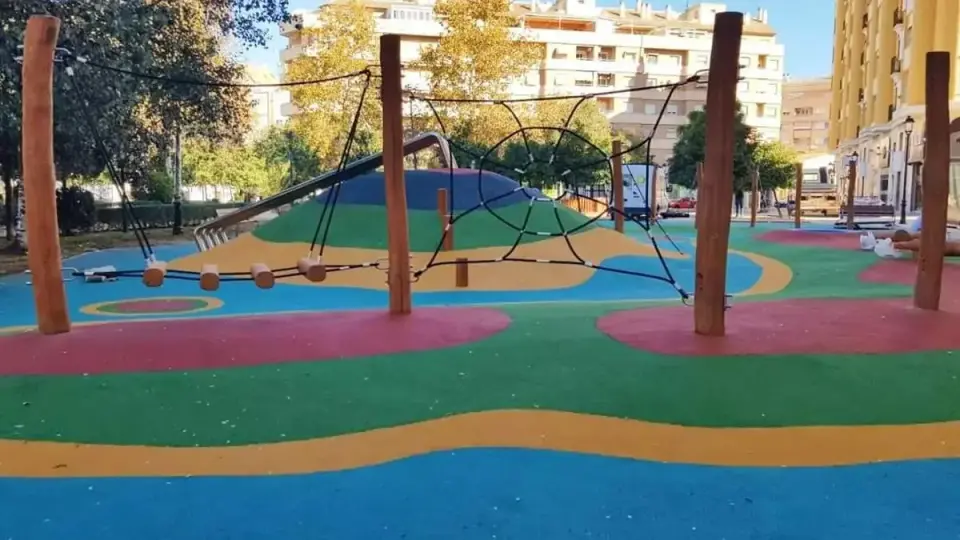
Coloured rubber flooring has become the standard solution in children's play areas in Dénia, and is now at the centre of a scientific debate about its possible toxicity, according to La Marina Plaza.
The Town Council has used it in various renovations. In 2021 it chose rubber for refurbishing one of the parks on plaza Jaume I, considering that the old tiles had lost their protective function. The slide park at Chabàs, opened in November 2023, has its entire surface covered in rubber, as does the park at the health centre, renovated in 2024. Rubber is also present, among others, in the parks on calle La Via, plaza del Arxiduc Carles, the junction of paseo del Saladar with Pintor Llorens and the end of the Cervantes esplanade.
What the studies say
Concern is grounded in research by the Institute of Environmental Diagnosis and Water Studies (IDAEA), part of Spain's National Research Council.
A study published in 2023 in Science of the Total Environment examined rubber from used tyres and synthetic EPDM rubber used in recreational surfaces. Researchers found metals and organophosphorus compounds, used as plasticisers and flame retardants, and called for buyers to have detailed chemical information about these materials.
Another paper, published in 2024 in Journal of Hazardous Materials, exposed different rubber granule materials to summer conditions for two months. It detected micro and nanoplastics and dozens of additives in the inhalable fraction, and observed toxic effects on aquatic organisms when simulating runoff, though at concentrations far higher than would be expected in the environment.
What they don't say
These results justify continuing research, but they do not demonstrate that playing in a park with rubber flooring causes illness in children. Nor do they describe the specific composition of the pavements installed in Dénia, which can vary from one installation to another.
What will happen in 2031
Around the debate circulates the idea that the European Union will ban these surfaces in 2031. This is not quite right. Regulation (EU) 2023/2055, on intentionally added microplastics, prohibits from 17 October 2031 the marketing of loose granular filling used in artificial grass sports fields. It does not require the removal of children's playground pavements.
The distinction matters. The regulation excludes particles that are permanently fixed in a solid matrix, as is the case with agglomerated rubber flooring in parks. In a 2024 parliamentary reply, the Government already distinguished between the two materials, though it recommended, as a precaution, studying the wear of children's pavements.
Outstanding questions
For Dénia, the debate raises specific questions: what materials each pavement is made from, what condition it is in, and what chemical and maintenance information is in the Town Council's files. Answering them requires reviewing each installation separately.