The Ronda Norte and the eternal championship of being right
Thirty years waiting for a road and eleven years of municipal government. In Dénia, some seem more concerned with winning arguments than getting things done.
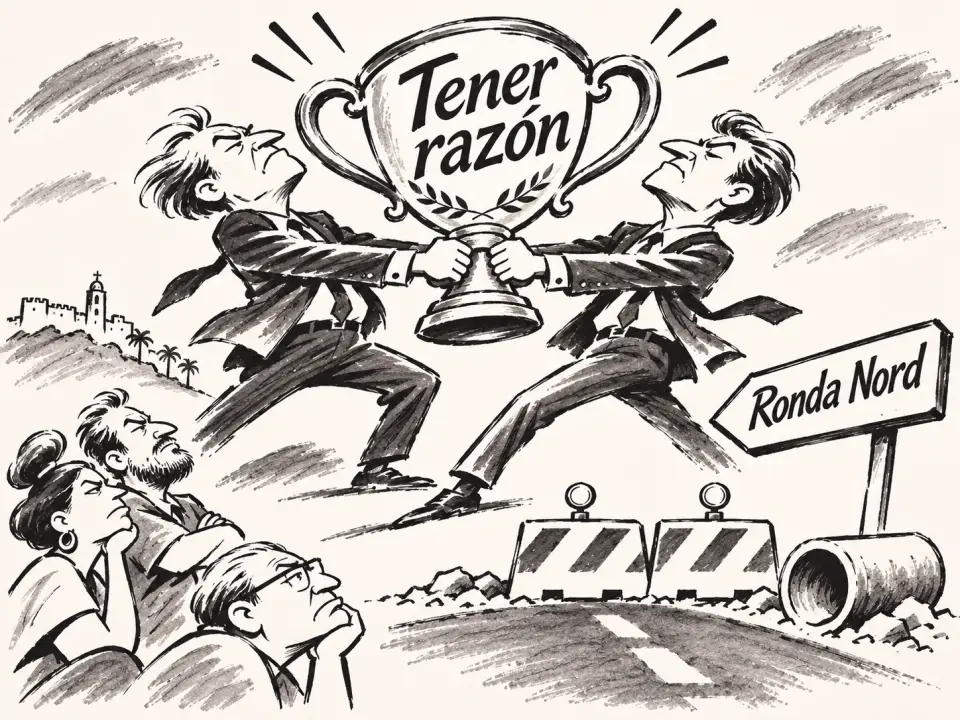
There are times when one hears certain political statements and wonders whether our representatives remember what they are there for. Whether their job is to permanently defend their positions, win every clash with another administration or, quite simply, solve citizens' problems. Because there is an enormous difference between defending the general interest and turning any disagreement into a matter of pride. The first requires responsibility. For the second, a press conference usually suffices.
The latest representation of this peculiar championship has the Ronda Norte as its protagonist. The Generalitat proposes an alternative to unblock a project pending for more than thirty years and the Town Council responds with its full repertoire of great calamities: "speculative building", "seizure of powers", ten-storey buildings and the inevitable spectre of Benidorm. Listening to them, anyone would think that the greatest danger to Dénia is that someone finally manages to build something.
It is worth recalling that the PSPV has governed Dénia since 2015, currently alongside Compromís. More than eleven years later, the Ronda Norte remains unbuilt. And now they announce that they are working on their own partial plan. Splendid. But perhaps citizens deserve something more than another statement of intent. When will it be approved? How will it be financed? Is it economically viable? When will work begin? Because after so many years, the verb working begins to need some complement. Preferably one that includes results.
And here we arrive at a question far less exciting than pronouncing the word "speculation", but infinitely more important: the numbers. Developing those land parcels costs millions of euros and owners will hardly assume such investment if the operation is not viable. Already in 2023 they formally questioned the reduction in development potential provided for in municipal planning. Were they right? It will have to be studied. Does current buildability allow the assumption of planning charges? It will have to be demonstrated. What does not seem too serious is dismissing an economic problem with a collection of qualifiers. Because a city model can be magnificent on paper, but if no one manages to develop it, it ends up being little more than a nice statement of intent. Admittedly, we can always pride ourselves on having defended it heroically.
And what of housing. Our leaders lament prices, demand solutions and defend protected housing. But when a proposal appears that contemplates increasing buildability, all alarms go off. The Town Council prides itself on reserving at least 40% for protected housing. Splendid. But how many homes does that percentage represent in each alternative? And how many will actually be built? Because 40% of a development that is never executed equals exactly zero homes. An extraordinarily comfortable formula for boasting of social commitment without the need to hand over a single key.
Nor would it be amiss to recall that a sustainable city is not necessarily one that builds the least. Contemporary urban planning defends adequate densities, compact neighbourhoods and efficient land use. Between turning Dénia into Benidorm and condemning a sector to another thirty years of waiting there should be some middle ground. Although finding it requires study, negotiation and doing the maths. Activities far less striking than announcing an urban catastrophe.
Of course the Town Council must defend its powers and the Generalitat must justify its proposal. But governing consists precisely of reconciling interests, finding viable solutions and knowing how to reach agreements. Powers are not trophies one can hang on oneself after winning an institutional battle. They are responsibilities that must be exercised to improve citizens' lives. And if there is speculation, let them demonstrate it with figures. If the municipal model is better, let them explain how and when they plan to implement it. What does not make much sense is turning every disagreement into a confrontation whilst problems remain intact.
Perhaps our representatives should remember that negotiating does not mean surrendering, that acknowledging another's argument is not a humiliation and that defending a position does not exempt one from demonstrating that it works. Dénia does not need more grandiose headlines, nor more institutional squabbles, nor politicians determined always to have the last word. It needs homes, infrastructure and administrations capable of reaching agreement.
Because political pride has a fascinating peculiarity: those who enjoy victory are not always those who pay its consequences. And in these disputes, the bill too often ends up reaching the same people.
In Dénia we have spent far too long confusing being right with doing things well. And our politicians should remember that winning an argument does not build a road.
Sources
Get La Marina Times in your inbox
The most relevant news of the Marina Alta every morning, or the week's most read every Friday.