A new surgical option
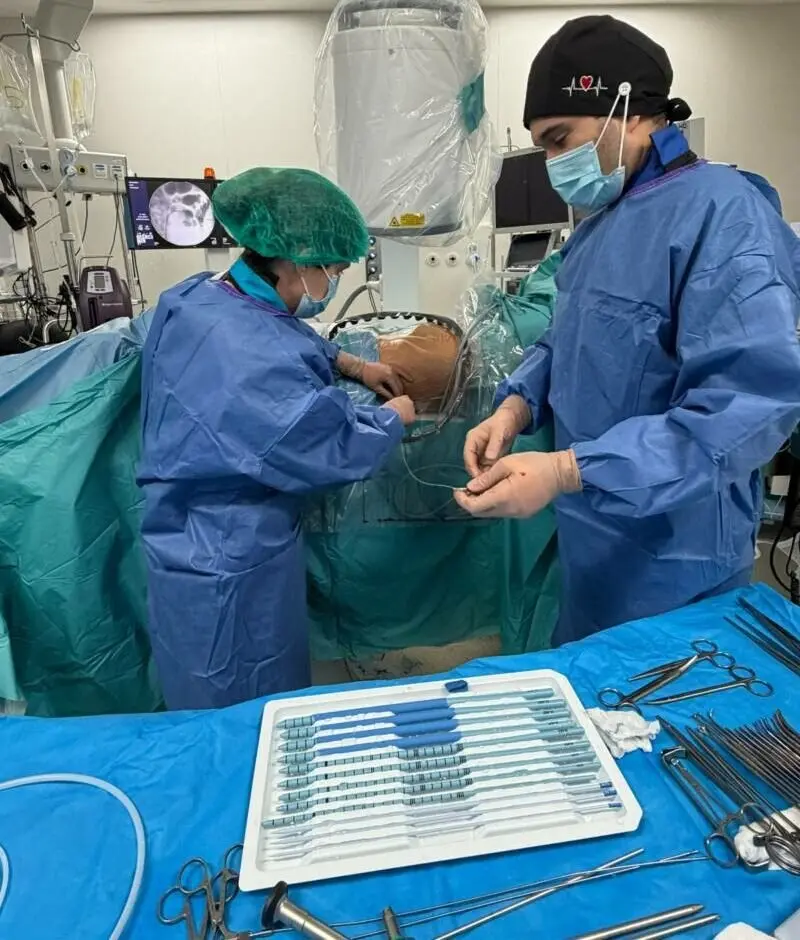
The Urology Service at Dénia University Hospital now has percutaneous nephrolithotomy available, a surgical method that allows large kidney stones to be treated with minimal trauma to the patient. The procedure is based on a puncture made in the lumbar region, through which specialists access the kidney to fragment and remove the stone in the same surgical procedure.
To locate the stone, specialists introduce contrast into the urinary tract and use radiological control, which allows them to gradually widen the pathway until reaching the kidney.
Commitment to innovation
The manager of Dénia's Health Department, Juan Puig, stated that "the incorporation of this technique reflects our commitment to healthcare innovation and continuous improvement in medical care", and added that it makes high-specialisation procedures available to patients thanks to a broader and more effective range of services.
For her part, the head of the Urology Service, Rebeca Polo, explained that this tool "completes all the therapeutic options available for the treatment of urinary stones".
Complement to the standard technique
To date, the service has mainly used retrograde endoscopic surgery with laser, a method that produces good results for smaller stones. Larger or more complex stones, however, may require specific procedures such as the one now incorporated. The essential difference between the two approaches lies in how the stone fragments are eliminated: with the retrograde technique the body naturally expels the fragments, whilst with the percutaneous approach they are extracted directly during the operation. With this addition, the Urology Service now has another alternative to decide, based on the characteristics of each case, which intervention is most appropriate.