PP, leading force in Alicante
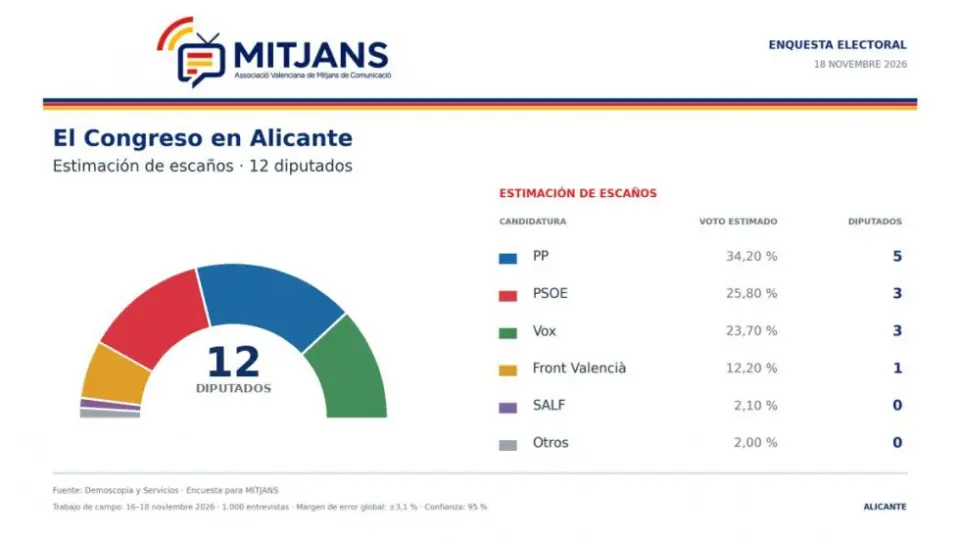
According to the projection, the PP would obtain 34.20% of the vote in Alicante province and 5 seats, ahead of the PSOE (25.80%, 3 seats) and Vox (23.70%, 3 seats). Front Valencià would achieve 12.20% and 1 seat, whilst SALF (2.10%) and other candidacies (2.00%) would fail to gain representation.
With regard to the 29 November election, the estimate keeps the PP at its 5 seats, although with a slightly lower percentage than the 36.73% achieved in 2023. The PSOE would fall from 4 to 3 seats, dropping from 32.00% to 25.80%, whilst Vox would rise from 2 to 3, with a jump from 16.25% to 23.70%. The poll clarifies that the seat that in 2023 corresponded to Sumar-Compromís (12.88%) is not equivalent to the one Front Valencià would now obtain.
Vox strengthens across the Valencian Community
At the level of the Valencian Community, the poll places the PP in first place with 31.86% of the vote and 12 seats, followed by the PSOE with 25.87% and 10 seats and Vox with 24.57% and 8 seats. Front Valencià would add 13.43% and 3 seats. The gap between socialists and Vox would be 1.30 points.
Comparison with 2023 results shows a decline for the PP, which would move from 34.87% to 31.86% and lose a seat (from 13 to 12), and a similar fall for the PSOE, which would drop from 32.13% to 25.87% and from 11 to 10 seats. Vox would be the party with the greatest variation: its support would rise from 15.65% to 24.57%, which would increase its representation from 5 to 8 seats.
Technical details and nuances
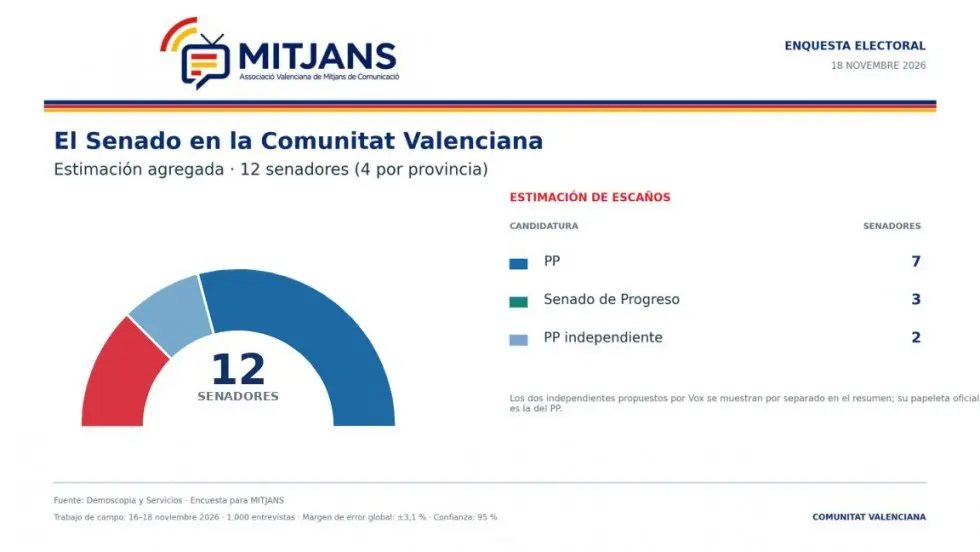
Fieldwork was carried out between 16 and 18 November 2026, with a sample of 1,000 interviews in the Valencian Community, 340 of them in Alicante province, and a declared overall margin of error of ±3.1% with a confidence level of 95%. The report also includes a projection for the Senate calculated from estimated vote transfers to Congress, not from a direct question about that chamber. The estimate does not break down specific results for Dénia or other municipalities in Marina Alta.
In presenting the results, MITJANS president Santiago Calaforra defended the usefulness of this type of proximity studies for journalistic work and stated: "Democracy needs plural, independent media capable of bringing reality closer to citizens".