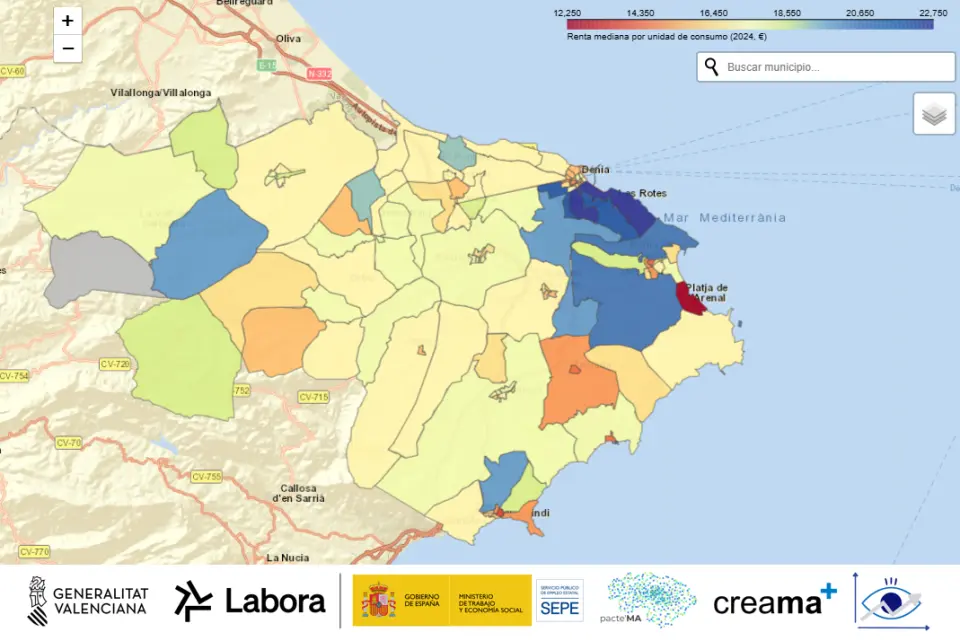
The Marina Alta Observatory has incorporated 2024 data into its interactive map and table of municipal incomes, allowing comparison of the comarca's situation with the average of the Valencian Community and analysis of its evolution since 2019. The analysis, based on 104 census sections, places the maximum difference between the highest and lowest income area at €10,500 annually, ranging from €12,250 to €22,750; the most favoured section exceeds the one with the lowest income by 85.7%.
The median income average of the 33 municipalities in the comarca stands at €17,383 annually, below the €18,550 average for the Valencian Community, a difference of €1,167 per year, as La Marina Times reported when covering the area's pensions.
Inequality within each municipality
The data show that differences exist not only between municipalities, but also within them. In Dénia, among its 25 census sections there is a gap of €9,100, with values ranging from €13,650 to €22,750. In Xàbia the range goes from €12,250 to €20,650, a difference of €8,400 equivalent to 68.6% between the extremes. Calp registers a gap of €6,300 between its areas, with incomes between €13,650 and €19,950, whilst in Teulada the internal difference is €3,500 and in Ondara, €2,800.
Evolution since 2019
Between 2019 and 2024, the median income of the different census sections grew between 13.3% and 54.5%, depending on the area. The highest increase was recorded in a section of Xàbia, on avenida Augusta and Primer Muntanyar, where income rose from €11,550 to €17,850. The most modest increases, of 13.3%, corresponded to a section in Dénia and another in Benissa.
To assess this evolution, the study uses as reference the rise in the Consumer Price Index in Spain between December 2019 and December 2024, of 18.8% according to the National Statistics Institute, and that in Alicante province over the same period, of 19.5%. Using the national inflation rate as a measure, 10% of comparable census sections experienced income growth lower than the price rise; if provincial inflation is applied, the percentage of sections that lost purchasing power rises to 14%.
The study has been promoted by CREAMA and PACTE'MA, within a project subsidised by the Generalitat Valenciana through LABORA and by the Ministry of Labour and Social Economy, and is based on data from the Atlas of Income Distribution of Households from the National Statistics Institute.